DuPont Circle | Washington, DC
Downtown McLean | Virginia

Recognized as a top oral surgeon in Washington, DC and McLean, VA for advanced same-day full-mouth implant treatment concepts
TeethXPress®
Understanding the Architecture of Your New Smile:
FP1 vs FP2 vs FP3
In the world of full-mouth permanent implant teeth, “FP” stands for Fixed Prosthesis. These classifications describe full-mouth, implant-supported restorations (bridges) based on how much natural tooth and gum tissue is replaced.
At Saltman Implantology & Oral Surgery in Washington, DC, FP1, FP2, and FP3 are the clinical standards used to describe how your new full mouth permanent implant-supported teeth emerge from your jaw to form your smile.
Each prosthesis type is designed to match your anatomy, bone structure, and aesthetic goals.
Choosing the correct prosthesis is one of the most important decisions in full-arch implant treatment—and one that requires advanced surgical and prosthetic expertise.
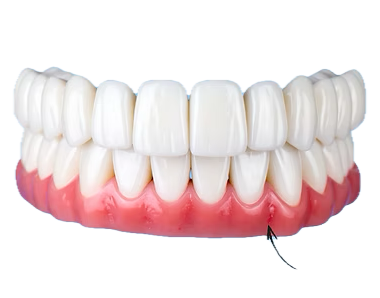
FP1
FP3
FP1 (Fixed Prosthesis 1): The Natural “Optimum Smile Recreation”
FP1 replaces only the visible portion of the teeth (the white crown portion), closely mimicking natural teeth in both shape and emergence from the gums. Ideal for patients with minimal bone and gum loss.

The Goal: To replace only the crowns of the teeth and to recreate your natural teeth exactly as they originally appeared.
The Aesthetic: The bridge emerges directly from your natural gum line—indistinguishable from real teeth.
The Requirement:
-
Excellent bone volume
-
High, healthy gum line
-
High technical precision
This is the most technically demanding form of full-mouth implant reconstruction. You need to be treated by an oral surgeon like Dr. Zach Saltman who has dual fellows in advanced surgical and prosthetic aspects of implant dentistry.


FP2 (Fixed Prosthesis 2): The Aesthetic Extension
FP2 replaces the white crown portion of your teeth and a small portion of the gum tissue to create proper proportions and aesthetics when some tissue loss has occurred.
The Goal:
To replace missing teeth while compensating for mild gum loss—either by slightly lengthening the crowns or by incorporating a small amount of pink restorative material to restore natural proportions and prevent an overly elongated appearance.
The Aesthetic: The teeth in an FP2 restoration are slightly elongated to compensate for minor bone or gum recession.
The Result: When designed with Dr. Saltman’s surgical and prosthetic expertise, the "longer" look of the teeth is hidden behind the lip line, providing a youthful and natural appearance without the need for artificial gum material.

Small amount of pink ceramic has been added to the final prosthesis
FP3 (Fixed Prosthesis 3): Comprehensive Facial Rejuvenation
FP3 replaces the teeth along with a more significant portion of gum tissue. This design is typically used when there has been moderate to severe bone and soft tissue loss, helping restore facial support and overall appearance.
FP3 is the standard type of design for All-On-4 treatment concept since during the implant surgery a significant reduction of jawbone is required.
The Goal: To replace teeth and the lost gum tissue (often called "pink porcelain" or acrylic).
The Aesthetic: This is the most common restoration for All-on-4 and Teeth-In-A-Day. It utilizes a small amount of gum-colored material to replace the tissue that has diminished over time.
The Benefit: Beyond just replacing teeth, an FP3 provides facial support. By restoring the lost volume in the jaw, it "lifts" the lower third of the face, often providing a rejuvenating effect similar to a subtle facelift.
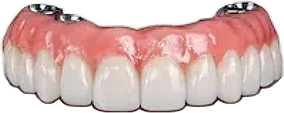

Classic All-on-4
Comparison Table FP1, FP2 and FP3 Full-Mouth Implant Teeth
Feature
Includes
FP1
FP2
FP3
Only the crowns( white potion of natural teeth above the gum)
Either elongated crowns or crowns with T minimum pink ceramic or acrylic to compensate the gum loss the gum
Crowns and extensive pink ceramic or acrylic to offset these significant bone and gum loss
Gum line
Completely natural
Natural appearance by adding minimum pink ceramic or acrylic around the teeth
Natural appearance by adding significant amount of pink ceramic or acrylic around the teeth
Bone and gum loss
Minimal
Moderate
Severe due to natural loss or significant jaw bone reduction as part of All-on-4 protocol
Look and feel
Most natural
Close imitation of natural teeth and smile
Close imitation of natural teeth and smile
Surgical complexity
Extremely technique sensitive. Requires highly skilled surgeon
Moderate
Moderate
Common use care
Healthy gum lone and no bone loss
Never gum and bone level sure to moderate bone loss
Severely resorbed jaw bone with flat gum anatomy
Surgical Complexity & Expertise Matter
The choice between FP1, FP2, and FP3 is a highly sophisticated clinical decision made by a highly skilled oral and maxillofacial surgeon, such as Dr. Zach Saltman in Washington, DC, who has subspecialty training in advanced implant reconstruction.
Planning and executing:
-
FP3 (All-on-4 design) → Less complex
-
FP1 design → Significantly more advanced and technique-sensitive
In reality, only a very limited number of oral and maxillofacial surgeons in the country—particularly in Washington, DC and surrounding areas—have the knowledge and clinical skills required to plan and perform FP1 designs.
Dr. Zach Saltman uses:
-
Advanced computer systems
-
Virtual implant planning software
-
Precision-driven surgical protocols
to determine exactly how much tooth and gum tissue must be restored for optimal results.
What Are The Key Characteristics of FP1 Full-Mouth Implant Teeth?
-
Designed to replace teeth only, not missing gum tissue
-
Aims for the most natural crown-and-bridge appearance
-
Requires healthy, well-positioned gums and sufficient bone volume
-
Typically supported by 6–8 or more implants per arch
-
Extremely technique-sensitive in both surgery and prosthetic design
FP1 restorations often require bone contouring, not to remove bone arbitrarily, but to create symmetry, ensure implant stability, and establish adequate restorative space.
The idea that FP1 represents “no bone modification” dentistry is a misconception.
Who Is a Good Candidate for FP1 Full-Mouth Implant Teeth?
FP1 candidacy is determined by the anatomy of your jawbone and gums, not personal preference alone. Strong FP1 candidates generally have:
Ideal candidates typically have:
-
Minimal bone and gum loss
-
Stable, healthy gum tissue architecture
-
A bite that has not collapsed over time
-
Adequate restorative space to maintain safe thickness for ceramic teeth and prosthetic components
Because FP1 replaces only teeth, the existing gum line must be capable of supporting a natural emergence profile.
If bone and gum contours (including the interdental papilla) are deficient, FP1 restorations may result in:
-
Overly long teeth
-
Boxy appearance
-
Asymmetry


Elongated crowns
Are There Any Smile Line Considerations for FP1 Full-Mouth Implant Teeth?
Smile line plays a critical role in FP1 restorations:
-
High smile line:
Any imperfection at the gum-tooth junction (any transition between teeth and gums) is visible, making FP1 highly and aesthetically demanding and higher risk.
-
Low smile line:
Minor imperfections may be masked, improving aesthetic predictability, even with less-than-perfect anatomy.
How Do I Know Which type of Implant-Supported Prosthesis Is Right for Me?
Determining whether FP1, FP2, or FP3 is not a matter of personal preference alone—it requires a precise diagnostic and treatment planning process.
This decision is based on:
-
Bone structure
-
Gum condition
-
Bite dynamics
-
Aesthetic goals
The Saltman Approach: Precision Meets Artistry
At Saltman Implantology & Oral Surgery, every case begins with advanced digital planning.
Your treatment is designed to:
-
Match your anatomy precisely
-
Optimize implant placement
-
Achieve the most natural aesthetic outcome possible
This is not a one-size-fits-all approach—it is a fully customized reconstruction.
What Is Your Next Step?
To find out which full-mouth implant prosthesis is best for you, Schedule your consultation with Dr. Zach Saltman today
by calling our office at 202-331-4110.
During your visit, you will receive a full diagnostic evaluation. You will undergo a comprehensive clinical examination along with advanced imaging and personalized digital treatment planning.
At the end of your consultation, Dr. Saltman will recommend the most appropriate option—FP1, FP2, or FP3—based on your unique anatomy, bone structure, gum condition, overall oral health and your long-term goals.
Ready to Design Your Ideal Smile?
Discover which full-arch implant solution is right for you—and achieve a smile that looks, feels, and functions like natural teeth.
Schedule Your Consultation Today